
Fire Pump Failure in Pascagoula Plant Reveals Critical ITM Gap
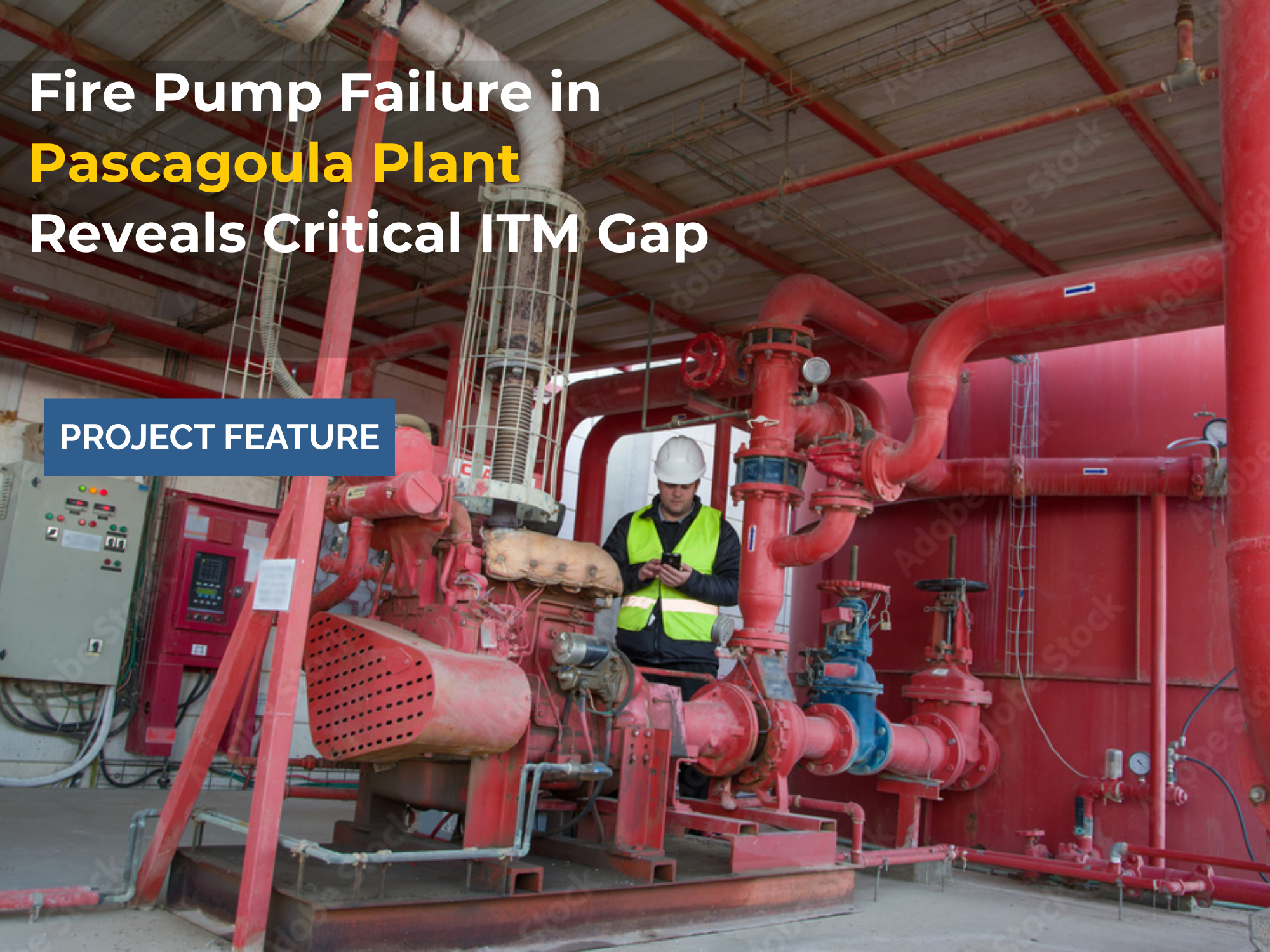
Service: Fire pump diagnostics and repair coordination, fire water storage tank and fire water infrastructure evaluation
Region: Pascagoula and the Gulf Coast
This article is for: Industrial facility leadership, EHS teams, maintenance and reliability managers
What caused the fire pump failure?
An industrial plant in Pascagoula, Mississippi contacted ICFP after experiencing a failure within their fire pump system. The pump had overheated due to a lack of water supply, and the on-site fire water storage tank was discovered to be empty.
The facility’s existing inspection, testing, and maintenance contractor had not properly evaluated the system, leaving a critical gap in the plant’s fire protection readiness.
With an inoperable fire pump and an empty fire water tank, the facility was left in a highly vulnerable condition with major operational consequences:
Life safety exposure for employees and contractors on site
Potential regulatory and code compliance violations tied to fire protection readiness
Increased insurance risk and heightened scrutiny after an impairment event
Catastrophic loss potential if a fire occurred while water supply and pumping capacity were compromised
Long-term operational risk, since the failure indicated broader oversight issues beyond a single component
When industrial fire protection systems fail, the real problem is rarely just the pump. It is the reliability of the entire chain: water supply, storage, valves, controls, underground fire mains, and the inspection routines that verify readiness.
The investigation
ICFP was recommended to the facility, and our team responded immediately.
Upon arrival, our technicians conducted a thorough evaluation of:
The fire pump system and immediate failure conditions
The fire water storage tank status and supply path
Related fire water infrastructure that impacts pump suction and system reliability
We quickly identified the root cause of the overheating and confirmed deficiencies in both prior inspection practices and overall system oversight.
The ICFP solution and why it worked
Industrial fire protection is not a place for checklist inspections or assumptions.
ICFP’s technical depth across fire pump systems, fire water tanks, underground fire mains, and large-scale industrial fire protection systems positioned our team to act decisively. Unlike contractors who outsource critical expertise or rely on check-the-box routines, our in-house capabilities allow accurate diagnosis and clear corrective planning.
Just as importantly, our commitment to transparent, fair service helped plant leadership regain confidence during a high-pressure event.
To restore reliability fast, our team moved from diagnosis to action:
Expedited procurement of required pump repair components
Coordinated a restoration plan to bring the pump, tank, and related system elements back toward full operational readiness
Maintained transparent communication with plant leadership throughout the response
Prioritized speed with discipline, ensuring the recovery path addressed the system, not just symptoms
This approach reduced uncertainty for the facility and created a clear line of sight from impairment to restoration.
The fire pump system is well on its way to full repair and restoration, significantly reducing the facility’s exposure and operational risk.
ICFP’s rapid response, technical competence, and straightforward communication earned the trust of plant leadership. As a result, we secured a new long-term customer relationship built on reliability, expertise, and accountability. The event reinforced the value of comprehensive ITM programs built around system-level verification, not surface compliance.
What industrial facilities can learn from this
If you operate an industrial site, fire protection reliability depends on more than passing an inspection. It depends on verifying the full chain of readiness:
Confirm the water supply and storage are actually available
Validate that inspections catch real-world failure modes, not just obvious deficiencies
Treat fire pump performance and water supply integrity as mission-critical operational infrastructure
Work with a partner who can diagnose complex issues and follow through until the system is truly stable
Fire pump failure and ITM FAQ
What causes a fire pump to overheat?
A common cause is running without adequate water supply (loss of suction, empty tank, closed or obstructed supply, or upstream supply problems). When the pump cannot maintain proper water conditions, heat builds rapidly and damages components.
Why would a fire water storage tank be empty without being caught?
Usually it points to weak inspection routines, missed documentation, or a lack of system-level verification. A strong program checks the supply, monitors trends, and escalates issues before they become impairments.
What should be evaluated after a fire pump failure?
Beyond the pump itself, facilities should assess the water source, storage tank, suction and discharge piping, valves, controls, alarm and supervisory signals, and the inspection history that should have flagged the risk earlier.
Do Not Wait for a Pump Failure to Expose a System Gap
If your facility relies on a fire pump and fire water storage, do not wait for a failure to find out the system is compromised.
Need help evaluating a fire pump impairment, verifying fire water supply integrity, or strengthening your ITM program along the Gulf Coast? Reach out to ICFP to schedule an assessment and review your current documentation and service plan.
