
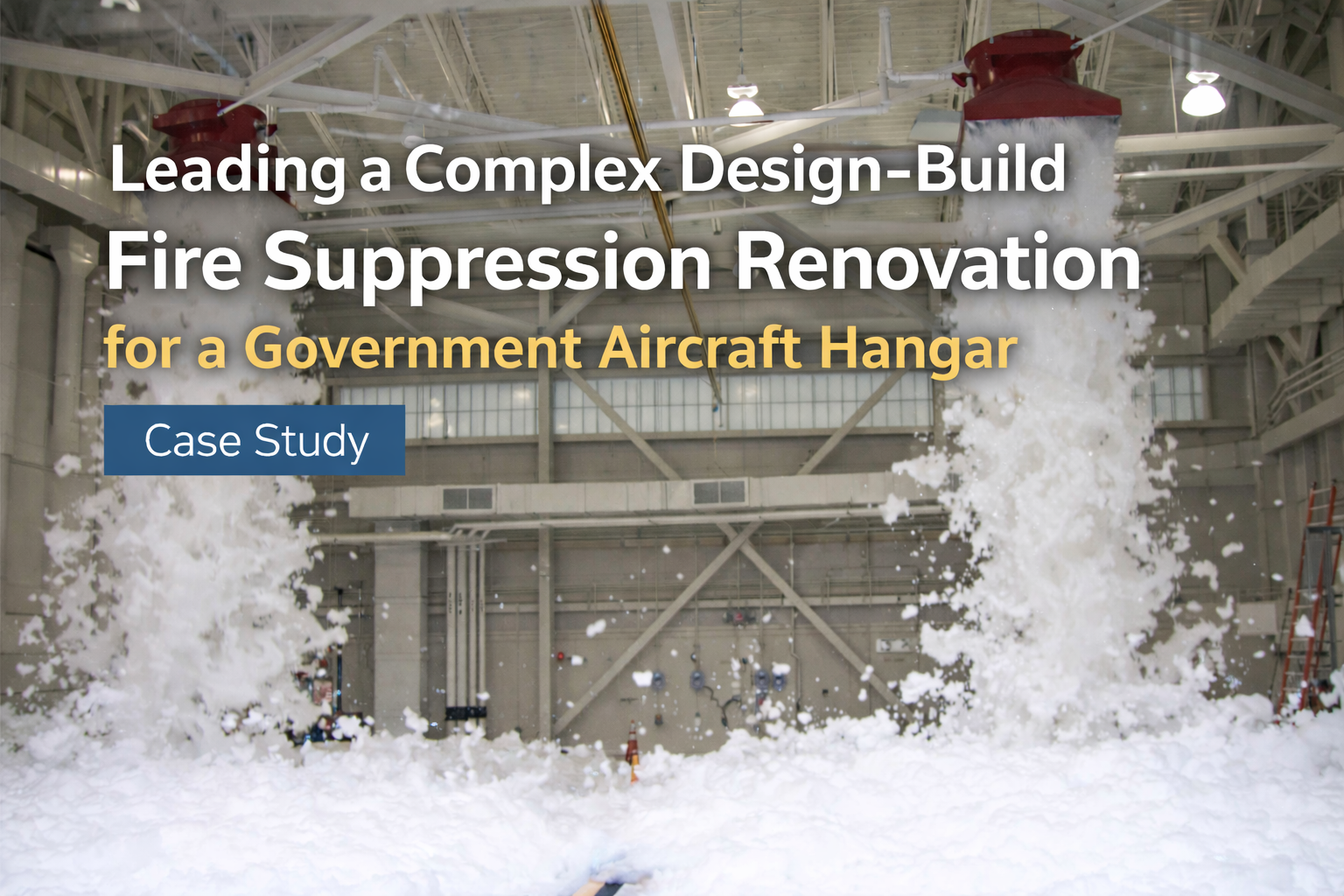
Leading a Complex Design-Build Fire Suppression Renovation for a Government Aircraft Hangar
The Challenge
A general contractor was awarded a large design-build fire suppression renovation at a government aircraft hangar. While experienced in construction delivery, the contractor lacked the specialized fire protection expertise required to manage a project of this complexity.
The scope involved advanced fire suppression and foam systems, strict government standards, and detailed coordination across multiple trades. Without experienced leadership in fire protection design and execution, the project faced significant risk from the start.
Why This Matters
Government aircraft hangars demand absolute precision. Fire suppression systems must meet rigorous performance, safety, and approval requirements. Any gaps in design, coordination, or execution can lead to delays, failed inspections, or rejected systems.
For the contractor, the stakes were high. Schedule pressure, approval challenges, and compliance risks threatened the success of the entire project.
The Risk and Business Impact
Without expert guidance, the project faced:
Delays tied to design approvals and submittal revisions
Coordination breakdowns between trades and system components
Increased risk of failing government inspections
Potential cost overruns and schedule impacts
A project of this scale required more than installation support. It required leadership.
Our Solution and Approach
Our team stepped in as the driving force behind the fire suppression scope, effectively providing the leadership needed to move the project forward.
We led the design-build effort from start to finish by:
Completing all fire suppression system design in house
Coordinating directly with authorities having jurisdiction
Hiring and managing specialty subcontractors
Performing all fire suppression work internally
Overseeing testing, commissioning, and final turnover
By keeping design, coordination, and execution under one roof, we eliminated common handoff issues and reduced risk throughout the project lifecycle.
Why This Solution Fit
Our in-house design and engineering team brings more than 100 years of combined fire sprinkler and suppression experience. That depth of knowledge allowed us to deliver systems that were accurate, buildable, and fully code compliant.
Because we self-perform design, fabrication, installation, and testing, there were no gaps between intent and execution. Communication stayed clear. Decisions were made quickly. Problems were solved before they became delays.
For a government project with no margin for error, that level of control mattered.
Execution
Using advanced CAD tools including REVIT and 3D modeling, our design team produced highly coordinated drawings that integrated cleanly with the overall project.
Our field crews executed installation with precision and care. Our project management team handled scheduling, coordination, inspections, and documentation, ensuring every requirement was addressed.
The result was a smooth installation process with minimal rework and clear visibility for all stakeholders.
The Outcome and Results
The project was completed on time and within budget. All systems were fully tested, approved, and accepted by the government without issue.
The customer benefited from:
Reduced project risk
Fewer coordination headaches
Clear communication throughout delivery
A successful, compliant fire suppression system
Most importantly, the project strengthened our reputation as a trusted partner for complex, high-expertise fire protection work.
A Trusted Partner for Complex Fire Suppression Projects
Design-build fire suppression projects require more than labor. They require experience, leadership, and accountability.
If you are planning a complex fire suppression project and need a partner who can lead from design through final acceptance, our team is ready to help.
Need support with fire suppression design, coordination, or execution?
Click here to contact us. We will get you to the right person and help you move forward with confidence.
